
The Spinner Model: A New Framework for Understanding Physical Literacy and Human Flourishing
By Olivia Hawes, IPLA Secretary
At the International Physical Literacy Association (IPLA), we believe physical literacy is about much more than movement competence or participation. It is about empowering people to lead active, meaningful, and fulfilling lives throughout the lifespan.
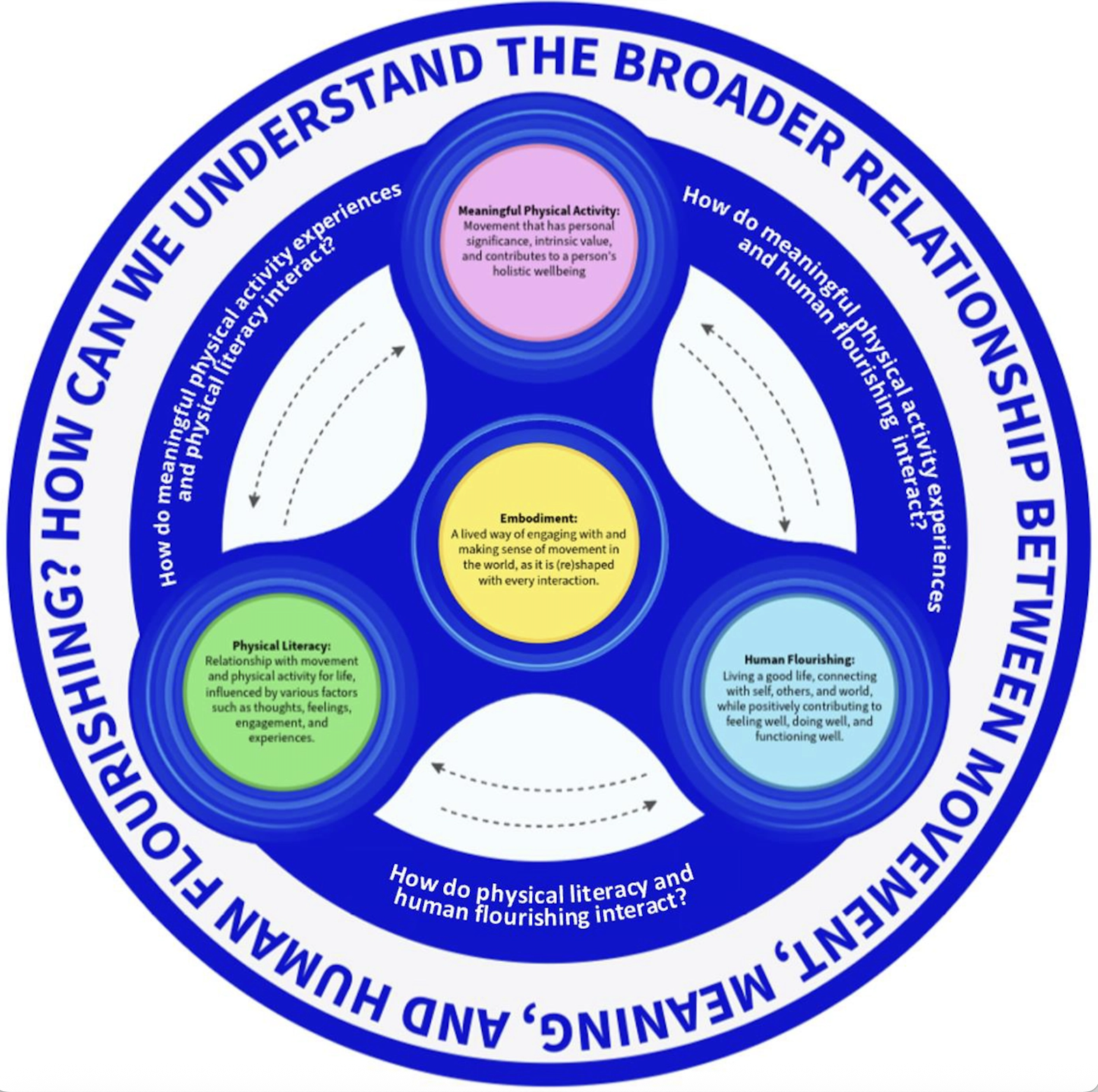
A recent paper published in Frontiers in Sports and Active Living introduces the Spinner Model for Flourishing through Movement, a conceptual framework that explores how physical literacy, meaningful physical activity, embodiment, and human flourishing are interconnected. The model invites us to think differently about why movement matters and how we might better design experiences that inspire lifelong engagement.
Here, we explore some of the key ideas from the paper and what they could mean for physical literacy research, policy, and practice.
Are We Asking the Right Question?
For years, efforts to improve public health have focused on one central objective: getting people to be more physically active. The rationale is clear. Regular physical activity reduces the risk of chronic disease, supports mental wellbeing, and contributes to healthier communities. Yet despite decades of campaigns, programmes, and policy initiatives, participation rates remain below recommended levels across much of the world. Perhaps the challenge isn’t simply encouraging people to move more. Perhaps it’s helping people discover movement that truly matters to them. This is the central premise of the Spinner Model. Rather than viewing physical activity as a prescription or obligation, the model encourages us to think about movement as an experience, one that can foster connection, identity, purpose, joy, and ultimately, human flourishing.
Physical Literacy at the Heart of the Conversation
For those working in physical literacy, these ideas will feel familiar. Physical literacy has always recognised that lifelong participation depends on far more than physical competence. Motivation, confidence, knowledge, understanding, and meaningful experiences all influence whether people choose to engage in movement throughout their lives. The Spinner Model builds upon these foundations. Rather than replacing existing understandings of physical literacy, it extends them by illustrating the reciprocality between physical literacy, meaningful physical activity, and human flourishing. Rather than replacing the question of how we create movement experiences that people genuinely value, the model helps us explore a deeper question:
How might meaningful movement experiences and physical literacy collectively contribute to people living healthier, more connected, and more flourishing lives?
In doing so, the Spinner Model offers a new way of bringing together ideas that have often been discussed separately, highlighting the dynamic relationship between physical literacy, meaningful physical activity, and wellbeing across the lifespan.
More Than Exercise
The model introduces the concept of meaningful physical activity. This is movement that resonates personally. It may be playing with grandchildren, walking with friends, dancing, climbing mountains, cycling to work, participating in cultural traditions, or simply experiencing the pleasure of moving outdoors. Meaning emerges from the individual, not from the activity itself. Two people may take part in exactly the same activity while experiencing it in entirely different ways. This reinforces an important message for practitioners. Successful programmes are not only those that increase participation. They are those that create environments where people feel capable, connected, autonomous, challenged, and welcomed. These experiences are often what sustain participation long after organised programmes have ended.
Flourishing Through Embodiment
Another important contribution of the Spinner Model is its emphasis on embodiment. The framework reminds us that we experience life through our bodies. Movement is not separate from thinking, learning, emotion, or relationships, it is woven through them. This holistic perspective aligns closely with the philosophical foundations of physical literacy, recognising individuals as integrated beings whose physical, cognitive, emotional, and social dimensions continually interact. Movement, therefore, becomes much more than exercise. It becomes part of how we experience ourselves and the world around us.
Why the Spinner?
The authors use the image of a spinner to represent the dynamic relationships between physical literacy, meaningful physical activity, embodiment, and flourishing. Like a spinning top, balance and momentum matter. Each element supports the others. As experiences become more meaningful, physical literacy can continue to develop. As physical literacy grows, people may seek new movement opportunities. These experiences, in turn, contribute to wellbeing and flourishing across the lifespan. Rather than presenting a simple linear pathway, the model recognises movement as an ongoing, evolving process.
What Does This Mean for Practice?
The Spinner Model challenges us to broaden our understanding of what success in physical literacy really means. Traditional measures of impact often focus on what is easiest to count: participation rates, frequency of activity, performance outcomes, or changes in physical capability. While these measures remain important, the Spinner Model encourages us to consider the wider human experience of movement. Success is not only about whether people are active. It is also about whether movement contributes to who people are, how they relate to others, and how they experience the world around them.
The Spinner Model does not suggest moving beyond physical activity outcomes; rather, it expands the lens through which we view them. By connecting physical literacy with meaningful physical activity, embodiment, and flourishing, the model reminds us that movement is not simply something people do, it is a fundamental part of human experience through which people can learn, connect, develop, and thrive.
Looking Ahead
As physical literacy continues to gain recognition internationally, frameworks such as the Spinner Model can help deepen the connections between philosophy, research, policy, and practice. Importantly, the model is not intended to provide a checklist, a set of outcomes to achieve, or a programme to implement. Rather, it offers a way of thinking, a conceptual lens that encourages critical reflection on how we understand movement, physical literacy, and human flourishing. For IPLA members, this provides an opportunity to engage with physical literacy in new ways. The Spinner Model invites researchers, educators, practitioners, policymakers, and community leaders to reflect on the assumptions that shape their work and to consider how movement experiences contribute to people’s lives beyond participation alone. At its heart, physical literacy has always been concerned with enabling people to engage with movement in meaningful and fulfilling ways. The Spinner Model offers another perspective through which we can explore, question, and perhaps deepen that vision. Rather than simply providing another measure of physical literacy, it encourages us to ask different questions about what movement means, why it matters, and how it can support people to flourish.
Read the Original Research
The ideas discussed here are drawn from the article The Spinner Model: Flourishing Through Movement—A Conceptual Framework Linking Physical Literacy, Meaningful Physical Activity and Embodiment, published in Frontiers in Sports and Active Living.
We encourage IPLA members and the wider physical literacy community to read the full paper and consider how its ideas might influence future research, practice, and policy.
As always, we welcome your thoughts. How do you create meaningful movement experiences in your own context? Join the conversation and share your reflections with the IPLA community.