
How Affordances Shape Physical Literacy and Quality of Life in Handball
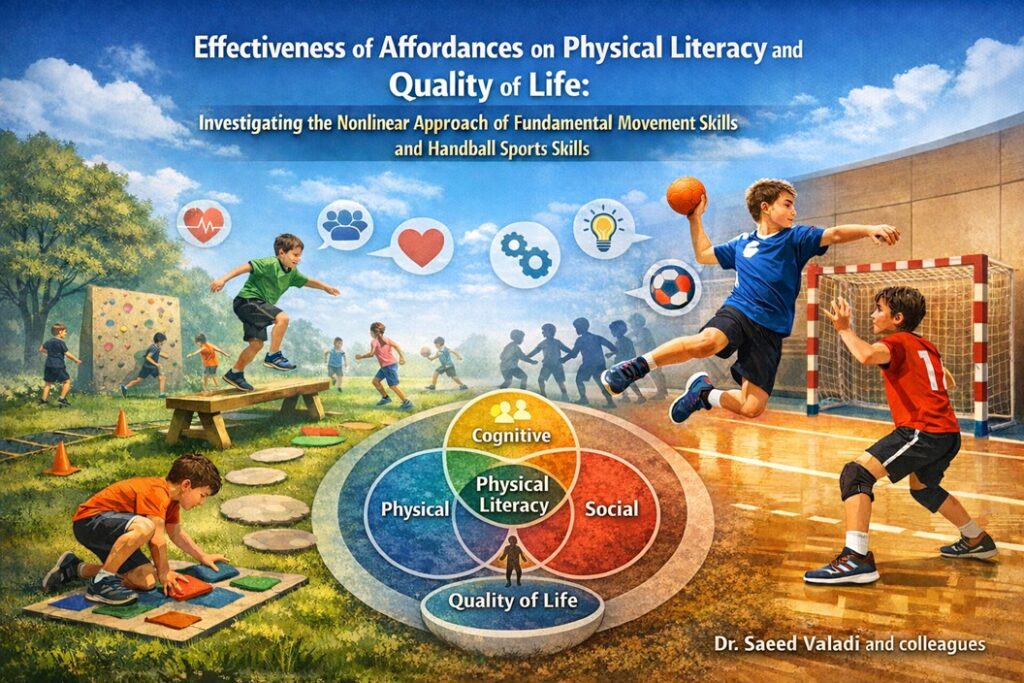
By Saeed Valadi and Colleagues
Introduction
Physical inactivity among children is an increasing global concern, contributing to obesity and a range of chronic health conditions. Encouraging children to move, play, and develop a wide range of skills is essential not only for physical health, but also for cognitive, emotional, and social wellbeing. A critical question, therefore, is how to support children to stay active and motivated over the long term. Physical literacy (PL) provides a comprehensive framework to address this challenge.
Introduced by Whitehead (2010), PL extends beyond fitness. It encompasses physical competence, motivation, confidence, knowledge, and understanding—key elements that together support an active and engaged lifestyle. Evidence indicates that enhancing PL during childhood positively impacts overall quality of life, including physical, psychological, and social dimensions (Talepasand & Safayee, 2014). Well-designed PL programs provide children with meaningful, enjoyable, and challenging movement experiences, fostering not only skill development but also confidence, motivation, and social interaction (Jurbala, 2015; Young, O’Connor, & Alfrey, 2020).
PL is dynamic and shaped by individual abilities and environmental influences. Ecological perspectives (Bronfenbrenner & Morris, 1998) emphasize that children learn best through interactions with their surroundings rather than through isolated skill drills. Exposure to diverse activities—such as running, jumping, throwing, balancing, cooperative games, and problem-solving tasks—supports motivation and enjoyment, encourages sustained participation in physical activity, and promotes social interaction and decision-making.
Our Study
Our study examined two innovative approaches to promote physical literacy in children aged 8–10 years: Non-Linear Pedagogy (NP) and the Constraint-Led Approach (CLA). Grounded in ecological dynamics, these approaches emphasize learner autonomy, adaptive skill acquisition, and engagement through creative task design. From a physical literacy perspective, ecological and nonlinear pedagogies are particularly valuable because they foreground meaning, interaction, and learner–environment relationships rather than the reproduction of idealised movement patterns.
At the micro level, individual and task constraints were manipulated to encourage exploration and movement adaptability, while at the meso level, environmental features such as space, rules, equipment, and social interaction were systematically modified. One intervention focused on Fundamental Movement Skills (FMS) through varied game-based activities, whereas the other targeted selected handball skills, including throwing, catching, and dribbling. In this study, fundamental movement and sport-specific skills were not treated as isolated outcomes, but as vehicles through which broader physical literacy attributes—such as motivation, confidence, enjoyment, and social engagement—were intentionally developed.
The six-week study involved 135 boys from two public schools in Urmia, Iran. Participants were randomly assigned to NP-FMS, NP-HSS (handball skills), or a control group following standard PE classes, which in Iranian public primary schools typically follow a nationally prescribed curriculum and are predominantly teacher-directed, focusing on basic sport skills. Pre- and post-tests assessed physical literacy using the Canadian Assessment of Physical Literacy (CAPL) and quality of life using the Pediatric Quality of Life Inventory (PedsQL).
Results
Both NP-FMS and NP-HSS groups demonstrated significant improvements in physical literacy and quality of life compared to controls. For example, children in the NP-FMS group displayed greater confidence and motivation during activities, voluntarily participating more actively, attempting novel movement solutions, and engaging more frequently with peers. Importantly, improvements in movement competence occurred alongside, and were supported by, gains in motivation, confidence, and willingness to engage, highlighting the holistic nature of physical literacy development. Quality of life improvements were most notable in physical and social domains, underscoring the broader developmental value of movement-based learning experiences.
Conclusion
These findings suggest that when movement is experienced as meaningful, enjoyable, and socially embedded, physical literacy develops as an integrated and embodied capacity rather than as a collection of discrete motor skills. Overall, findings support the effectiveness of ecological and constraint-led approaches in fostering skills, confidence, motivation, and enjoyment in movement (for details on age-related differences, see the full article).
Full article and Reference List
Valadi, S., Dehghanizadeh, J., Gabbard, C. et al. (2025). Effectiveness of affordances on physical literacy and quality of life: investigating the nonlinear approach of fundamental movement skills and a selection of handball sports skills. BMC Pediatr 25, 575. https://doi.org/10.1186/s12887-025-05916-x