
IPLA X WildStrong Podcast Summary
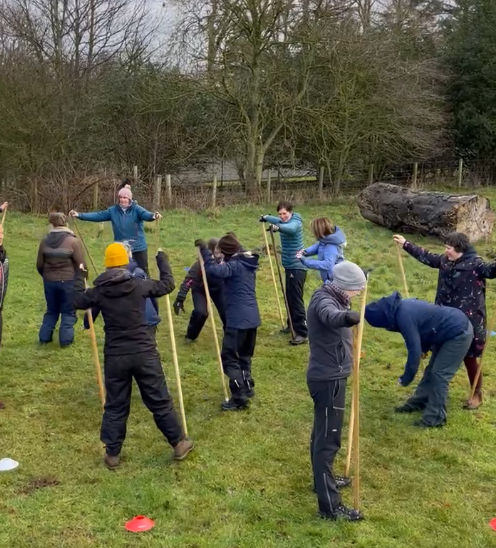
“I can’t believe all the movements I’ve been trying to do that I never would have thought possible before!”
Andrew Telfer from WildStrong in Discussion with Gillian Bartle, on Physical Literacy
This blog is a summary of the podcast, facilitated by Andrew at WildStrong. In the podcast we discuss physical literacy (PL) and the overlap that key aspects of PL have with the work Gill and Andrew do at WildStrong. Andrew has a background in a range of movement contexts, including sport science, fitness, coaching and personal training. Gill and he have developed practice-based, outdoor strength and conditioning activities, and alongside a team at WildStrong they deliver courses and classes to a range of populations – often with a focus on older adults (see their Nature Moves site). In the podcast, the experiences of Gillian and Andrew find synergy in that we are both advocates of a PL-enriched approach to encouraging moving in others.
WildStrong have re-thought how people approach maintaining or developing strength and movement confidence throughout life. The mantra on their opening pages of the website reads “we don’t just need exercise; we need confidence, community, and a way to move that fits our real lives”. Thus strength, skill, balance, flexibility are all experienced through playing, climbing, lifting, carrying, and enjoying physical activities that stem from everyday embodied moving.
WildStrong embeds emergent learning, fostering problem-solving and exploration through movement tasks and play. Similarly, in the podcast, I refer to my experiences across physical education (PE), teacher education, further education and academia, and how we learn to move. Both WildStrong and me wonder what gets lost when movement is over-structured, over-measured, or over-scripted. This last finding relates to my PhD thesis (Bartle, 2025), wherein student primary education teachers could go ‘off-script’ (that is, off their lesson plans) in between COVID lockdowns when teaching PE. Students enacted PL-enriched PE during this period.
The social aspects of playing and moving together form part of WildStrong’s inclusive, community philosophy. Participants are quoted on the website as saying, “It’s more than movement, it’s about building confidence, understanding the barriers and creating in-person connections”. Synergy with PL also includes developing confidence, knowledge and understanding and enabling people to be motivated to be physically active throughout life (Whitehead, 2010). The connectivity with others whilst enjoying movement, is central to enabling wider health benefits, such as combatting feelings of isolation.
Andrew and I explore PL as a disposition, rather than a programme or policy (Milne, 2024), aligning with Whitehead’s (2010) original conceptualisation (Durden-Myers et al., 2022). An ongoing relationship with movement, rooted in meaning, confidence, curiosity and experiences is discussed as an holistic way of encouraging individuals to value moving.
Alongside my discomfort with assessment systems that value written knowledge over embodied knowing, Andrew and Gill at WildStrong entwine moving-and-learning-together, as a non-dualist philosophy. This was the basis of Whitehead’s (1987) PhD thesis wherein she problematised some conceptions of PE, such as those that narrow the experiences of pupils and devalue embodied knowing. For further reading on this, colleagues and Gillian explore Physical Literacy and Intentionality: Embodied Beckoning (Durden-Myers et al., 2021). The discussion in the podcast follows this line of thought, where the risks of normalising developmental benchmarks, the limits of fitness-led approaches, and why valuing movement cannot be reduced to sets, reps, or gym memberships is woven through discussion. This is not to devalue gym activities and indeed, promoting variety of movement choice and experience is reinforced by Andrew and Gillian.
Woven through discussion is a broader question: do we, as a society, value movement – and if not, what might help restore it as part of everyday life? WildStrong certainly offer positive and life-enhancing experiences, as reflected in the title of this blog which is a quotation from one of the 69-year-old participants. For anyone interested in finding out more, visit the WildStrong website, and contact Gill or Andrew. I will follow-up this blog once I have had the pleasure of experiencing WildStrong in action, over two weekends in Fife, Scotland. Watch this space …
Meanwhile, you can listen to the full podcast here: https://creators.spotify.com/pod/profile/wildstrong/episodes/34–Dr-Gillian-Bartle–Learning-to-value-movement-throughout-our-lives-e3du9g1/a-ace4q7h
Bartle, G. F. B., 2025. Materialising Physical Literacy: rethinking physical education. Unpublished PhD Thesis. Stirling: University of Stirling.
Durden-Myers, E. J., Bartle, G., Whitehead, M. E. and Dhillon, Karamjeet K., 2021. Physical Literacy and Intentionality: Embodied Beckoning. Journal of Physical Education, Recreation & Dance, 92:9, 42-4. Available at: https://www.researchgate.net/publication/357579666_Physical_Literacy_and_Intentionality_Embodied_Beckoning [Accessed Jan 26 2026].
Durden-Myers, E. J., Bartle, G., Whitehead, M.E. and Dhillon, Karamjeet K., 2022. Exploring the Notion of Literacy Within Physical Literacy: A Discussion Paper. Front. Sports Act. Living 4:853247. DOI: 10.3389/fspor.2022.853247
Milne, L. (with Bartle, G.), 2024. Physical Literacy as a foundation for Physical Education in Scottish Primary Schools, IPLA Blog.
Whitehead, M. 1987. A Study of the Views of Sartre and Merleau-Ponty relating to Embodiment, and a Consideration of the Implications of these Views for the Justification and Practice of Physical Education. Unpublished PhD Thesis. London: Institute of Education, University of London.
Whitehead, M. (ed.), 2010. Physical Literacy Across the Life Course. Routledge.