
WildStrong Course: Follow Up
By Dr. Gillian Bartle, Research Lead, IPLA
Remember the blog about WildStrong’s (22nd Feb.,2026) outdoor movement for life course, where I participated in play to develop strength, balance, coordination and importantly, fun? This is part two and I would like to share some practical ideas so that an idea of ‘what’, ‘how’ add to the ‘why’ of playing outside with other adults!
The premise behind the movements includes them being related to how people move and will move as they progress through life. Strength combined with balance or coordination reflects how objects and bodies-with-objects are moved around. Physical literacy enriches the WildStrong approach because they account for enjoyment, building confidence and creating motivating factors for individuals to understand how-why moving is valuable throughout life. Everyone embodies the experiences of moving with or without objects, in their specific way, thus enacting PL’s philosophies of existentialism and phenomenology. In addition, doing the movements rather than merely learning about them through theory or models means the approach is monist and not dualist.
The range of playful movements brings experiences like being able to bend down, pick up something, and get back up with that object in hand; or being able to cope with uneven surfaces, falling safely but also being able to move about on the ground comfortably and get back up. There are clearly implications for moving into older adulthood or rehabilitating after injury or surgery.
Images 1 & 2 below show an activity wherein two people play at pushing a ball around in a ‘figure of eight’ whilst not bumping into one another, with the other players lying on their backs whilst ‘walking’ with arms and legs in the air. The ball partners are working at being mobile on all fours whilst pushing the ball, the other two are working their cores. All four players must get back up.
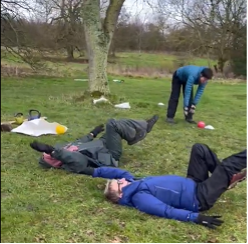
Image 1
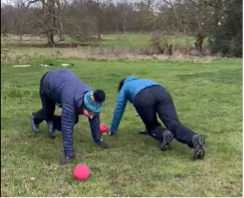
Image 2
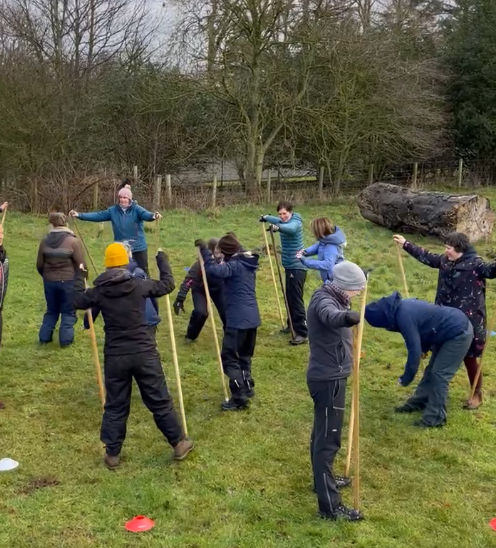
How does someone get back to their feet? Roll onto one side, onto hands and knees, then sit back onto bent legs, place one foot flat and pushing on that knee to raise up to standing. Phew! Breaking it down, that is a lot of manoeuvring and is only one option. Having the capacity to put weight on the hands is coupled with some range of movement of the upper body. Maintaining and developing mobility in the upper body is explored using a broom handle! Moving a broom handle/wooden dowel around provides a lovely feeling of flow, of spinal fluidity if you reach up with one arm then down and across to the opposite foot. It helps flexibility of an area often not thought about in comparison to the lower body.
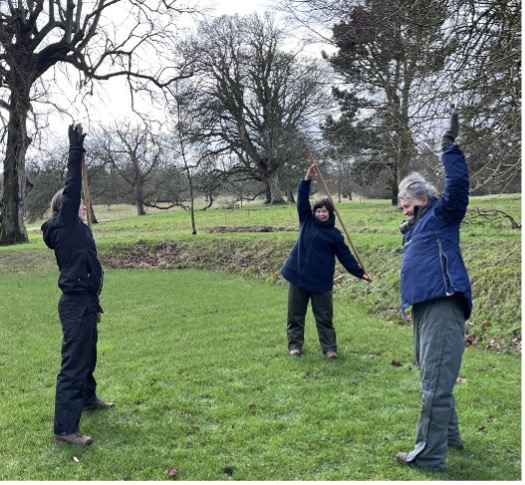
Image 3
To practice these movements throughout life is to maintain and develop embodied knowledge. The images below show group game playing – ‘fighting’ with home-made swords and playing at hitting the dowels as folks move around with them on the tops of their feet. These games and items are adaptable, accessible, inexpensive and encouraging of having fun. Trying out movements that encourage extensions of the ‘everyday functioning’ type could be incorporated into any lifestyle. We played on ground that was not dry, it was late January but with the motivation from those in the group and the context for movements, participation was easy. Try leaning on walls or tree trunks on the walk to work, jumping down two steps landing on two feet with bent knees as you walk through campus or the shopping centre; lift your rucksack above your head for twenty steps, change arms – lower it with control. These are just some ideas that I hope provoke thinking about how to incorporate strength, balance, coordination and stability into the everyday and a little beyond.
- gillian.bartle@physical-literacy.org.uk
(All photos CC from group participants, thank you.)